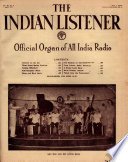
THE INDIAN LISTENER
Vol. III. No. 8. (7th APRIL 1938)
by Howard Boatwright
Pages
76
Reading Level
Intermediate
Est. Time
1.9 hrs
Description
The Indian Listener (fortnightly programme journal of AIR in English) published by The Indian State Broadcasting Service,Bombay ,started on 22 december, 1935 and was the successor to the Indian Radio Times in english, which was published beginning in July 16 of 1927. From 22 August ,1937 onwards, it was published by All India Radio,New Delhi.In 1950,it was turned into a weekly journal. Later,The Indian listener became "Akashvani" in January 5, 1958. It was made a fortnightly again on July 1,1983. It used to serve the listener as a bradshaw of broadcasting ,and give listener the useful information in an interesting manner about programmes,who writes them,take part in them and produce them along with photographs of performing artistS. It also contains the information of major changes in the policy and service of the organisation. NAME OF THE JOURNAL: The Indian Listener LANGUAGE OF THE JOURNAL: English DATE,MONTH & YEAR OF PUBLICATION: 07-04-1938 PERIODICITY OF THE JOURNAL: Fortnightly NUMBER OF PAGES: 76 VOLUME NUMBER: Vol. III, No.8. BROADCAST PROGRAMME SCHEDULE PUBLISHED(PAGE NOS): 503-560 ARTICLE: 1. Jacques Offenbach 2. Indo-European Music 3. 'There And Back Again' (A Talk Broadcast From Delhi In March) 4. New Stations On Old Receivers - II By "Trouble Shooter" 5. A Doctor Looks Back…(In A Talk Recently Broadcast From Bombay) 6. Lucknow On The Air 7. Rural Primary Schools (A Talk Broadcast From Delhi in March) 8. Three Great Spring Festivals (Easter-Holi-Moharram) AUTHOR: 1. J. G. N. Brown 2. Unknown 3. F. E. Edwards 4. Unknown 5. M. D. Gilder 6. J. E. Parkinson 7. Unknown 8. Unknown KEYWORDS: 1. Opara House, Universal Entertainer, The Tales Of Hoffman, Jacques Offenbach 2. Anti-Tuberculosis Fund, Indo-European Concert, Delhi Regal Theatre, Western Music, Indian Music 3. India, Europe, Returning Home, Towel Of Babe, League Of Nations 4. Delhi, Old Radio Sets, Tuning The Receiver, Oscillator Frequency, Signal Frequency 5. Mental Hospital, Cure For Depression, T. D. Welankar, Quackery In Medicine 6. Rural Primary Schools, Vidya Mandir Scheme, Women Teachers, Central Advisory Board Of Education 7. All India Radio, April 2, College Of Music, Lucknow Broadcasting Station, Gobind Ballabh Pant 8. Hindus, Muslims, Christians, Holi, Easter, Festival, Moharram Document ID: INL - 1938 ( J-D) Vol -I (08)
ISBN-13: N/A
Publisher: All India Radio (AIR),New Delhi
Language: English
Publish Year: 1938
AI Synthesis & Core Summary
Howard Boatwright's work, particularly his insights into Indian classical music for a Western audience, serves as a crucial bridge between two distinct musical philosophies. As a trained Western musician and composer who immersed himself in the intricacies of Indian traditions, Boatwright offers a unique comparative perspective. His writings and teachings aim to demystify the seemingly alien structures of Indian music, translating its fundamental concepts into terms accessible to those accustomed to Western harmony, counterpoint, and fixed compositions. He emphasizes that true appreciation requires moving beyond superficial listening to understand the underlying theoretical and philosophical frameworks.
The core of Boatwright's analysis delves into the foundational elements of Indian classical music: the raga and the tala. He meticulously explains that a raga is far more than a mere scale; it is a melodic entity imbued with specific characteristic phrases, emotional connotations (rasa), and prescribed movements, often associated with particular times of day or seasons. Similarly, he elaborates on the concept of tala, the complex rhythmic cycles that underpin improvisation, emphasizing its cyclical and iterative nature as opposed to the linear rhythmic progression common in much Western music. He highlights the role of structured improvisation, where musicians express creativity within the rigorous discipline of raga and tala.
Ultimately, Boatwright's contribution lies in fostering cross-cultural musical literacy. By meticulously dissecting and illuminating the nuances of Indian classical music, he encourages Western listeners to re-evaluate their own musical preconceptions and embrace new modes of auditory perception. His work not only educates but also inspires a deeper respect for the universality of musical expression while celebrating the distinct beauty of India's ancient sonic heritage, thereby enriching the global understanding of music as an art form and a cultural phenomenon.
AI Concept Mind-Map
Get This Book
Looking to add this masterpiece to your bookshelf? Compare prices and buy directly using our trusted partners:
🔔 Get Price Drop Alerts
Enter your email to receive an instant notification when this book's price drops on Amazon or Flipkart.
As an Associate, BOOKLOVE earns from qualifying purchases. Read our full Affiliate Disclosure.
Critical Lessons & Takeaways
- Understanding a foreign musical tradition demands a shift in perceptual paradigms, moving beyond one's ingrained cultural listening habits.
- Ragas are living melodic personalities, each with unique emotional content and structural integrity, not just abstract scales.
- Tala provides a sophisticated cyclical rhythmic framework that emphasizes continuous evolution and subtle interplay over static meter.
- Improvisation in Indian classical music is a highly disciplined art form, built on deep knowledge and mastery of theoretical structures rather than unbridled spontaneity.
- Engaging with diverse musical systems enhances one's overall musicality and broadens appreciation for the vast spectrum of human artistic expression.
Famous Quotes & Key Sayings
- "Indian classical music offers a profound journey into melodic and rhythmic improvisation, unlike anything in the Western canon."
- "The raga is not merely a scale, but a living, evolving entity, imbued with specific emotional and aesthetic characteristics."
- "To truly listen to Indian music is to surrender to its cyclical time and embrace its unique expressive freedom within strict discipline."
- "The Western ear, accustomed to harmony, must reorient itself to the subtle nuances of monophonic melody and rhythmic intricacy."
Key Figures & Characters
AI Book Assistant
Ask about quotes, characters, lessons...
Offline Study Companion
Download the complete AI Summary and Critical Lessons as a beautifully formatted PDF to read offline.
📅 Create AI Reading Plan
Generate a week-by-week timeline custom-tailored to your learning goals and timeline.
Community Reviews (0)
No reviews posted yet. Be the first to share your thoughts!
Similar Books & Comparisons

The Lean Startup

Zero to One

The Psychology of Money