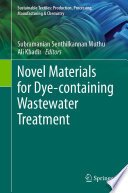
Novel Materials for Dye-containing Wastewater Treatment
by Subramanian Senthilkannan Muthu
Pages
233
Reading Level
Intermediate
Est. Time
5.8 hrs
Description
This book highlights novel materials for dye-containing wastewater treatment and presents an up-to-date information on dye degradation/adsorption using new promising materials such as nanocomposites. Development of various industrial sectors, including textile, food, paper, leather, rubber, cosmetic and printing has led to generation of wastewater which contain dye molecules as well as other inorganic and organic compounds. Considering serious health hazards and environmental damage associated with dyes in the environment, researchers and professionals have been attempting to find the most effective methods of treatment. Of late, various composites have received wide attention due to their outstanding properties in wastewater treatment, that are presented in this book.
ISBN-13: 9811628920
Publisher: Springer Nature
Language: English
Publish Year: 2021
AI Synthesis & Core Summary
Subramanian Senthilkannan Muthu's "Novel Materials for Dye-containing Wastewater Treatment" meticulously addresses the critical environmental challenge posed by industrial dye wastewater. The book begins by highlighting the severe ecological damage and health risks associated with untreated dye effluents, emphasizing their non-biodegradable nature, toxicity, and aesthetic pollution. It critically evaluates the limitations of conventional wastewater treatment methods, such as coagulation, flocculation, adsorption with traditional materials, and biological processes, which often suffer from low efficiency, high operational costs, secondary pollution generation, or limited applicability to diverse dye structures. This foundational discussion sets the stage for the urgent need for innovative and sustainable solutions.
The core thesis of the book revolves around the paradigm shift towards utilizing advanced and novel materials for efficient dye removal. It extensively explores various cutting-edge materials, including different classes of nanomaterials (e.g., carbon nanotubes, graphene, metal-organic frameworks, semiconductor photocatalysts), biopolymers, hybrid composites, and membrane technologies. The book delves into the synthesis, characterization, and mechanistic aspects of these materials, detailing how their unique properties – such as high surface area, tunable pore size, specific functional groups, and catalytic activity – enable superior adsorption, degradation, or separation of complex dye molecules. It provides a comprehensive overview of the principles behind adsorption, photocatalysis, electrochemical degradation, and membrane filtration, showcasing how these materials enhance each process.
Ultimately, the book serves as a vital resource for researchers and practitioners, advocating for a sustainable future in industrial wastewater management. It not only presents the scientific advancements but also discusses practical applications, scalability issues, cost-effectiveness, and the potential for industrial implementation of these novel materials. By thoroughly reviewing the current state-of-the-art and identifying future research directions, Muthu's work underscores the transformative potential of material science in mitigating one of the most persistent environmental pollutions, promoting resource recovery, and fostering circular economy principles in the textile and dyeing industries.
AI Concept Mind-Map
Get This Book
Looking to add this masterpiece to your bookshelf? Compare prices and buy directly using our trusted partners:
🔔 Get Price Drop Alerts
Enter your email to receive an instant notification when this book's price drops on Amazon or Flipkart.
As an Associate, BOOKLOVE earns from qualifying purchases. Read our full Affiliate Disclosure.
Critical Lessons & Takeaways
- The detrimental environmental and health impacts of dye-containing wastewater necessitate urgent and effective treatment solutions.
- Conventional wastewater treatment technologies often fall short in efficiently and sustainably removing complex dye molecules.
- Novel materials, particularly nanomaterials and advanced composites, offer significantly enhanced adsorption, degradation, and separation capabilities for dyes.
- Sustainable and cost-effective material development is crucial for scalable industrial implementation of advanced wastewater treatment processes.
- An interdisciplinary approach combining materials science, chemistry, and environmental engineering is essential to develop innovative and eco-friendly remediation strategies.
Famous Quotes & Key Sayings
- "The persistent challenge of dye wastewater demands a transformative shift from conventional remediation to innovative material-centric solutions."
- "Harnessing the unique properties of novel materials is not merely an advancement, but a necessity for achieving true sustainability in industrial effluent treatment."
- "Effective dye removal transcends mere compliance; it is fundamental to safeguarding aquatic ecosystems and ensuring public health worldwide."
- "The future of wastewater treatment lies in the smart design and application of materials that are not only highly efficient but also regenerable and environmentally benign."
Key Figures & Characters
AI Book Assistant
Ask about quotes, characters, lessons...
Offline Study Companion
Download the complete AI Summary and Critical Lessons as a beautifully formatted PDF to read offline.
📅 Create AI Reading Plan
Generate a week-by-week timeline custom-tailored to your learning goals and timeline.
Community Reviews (0)
No reviews posted yet. Be the first to share your thoughts!
Similar Books & Comparisons

Fish Roe

Clean Code
The Lean Startup